
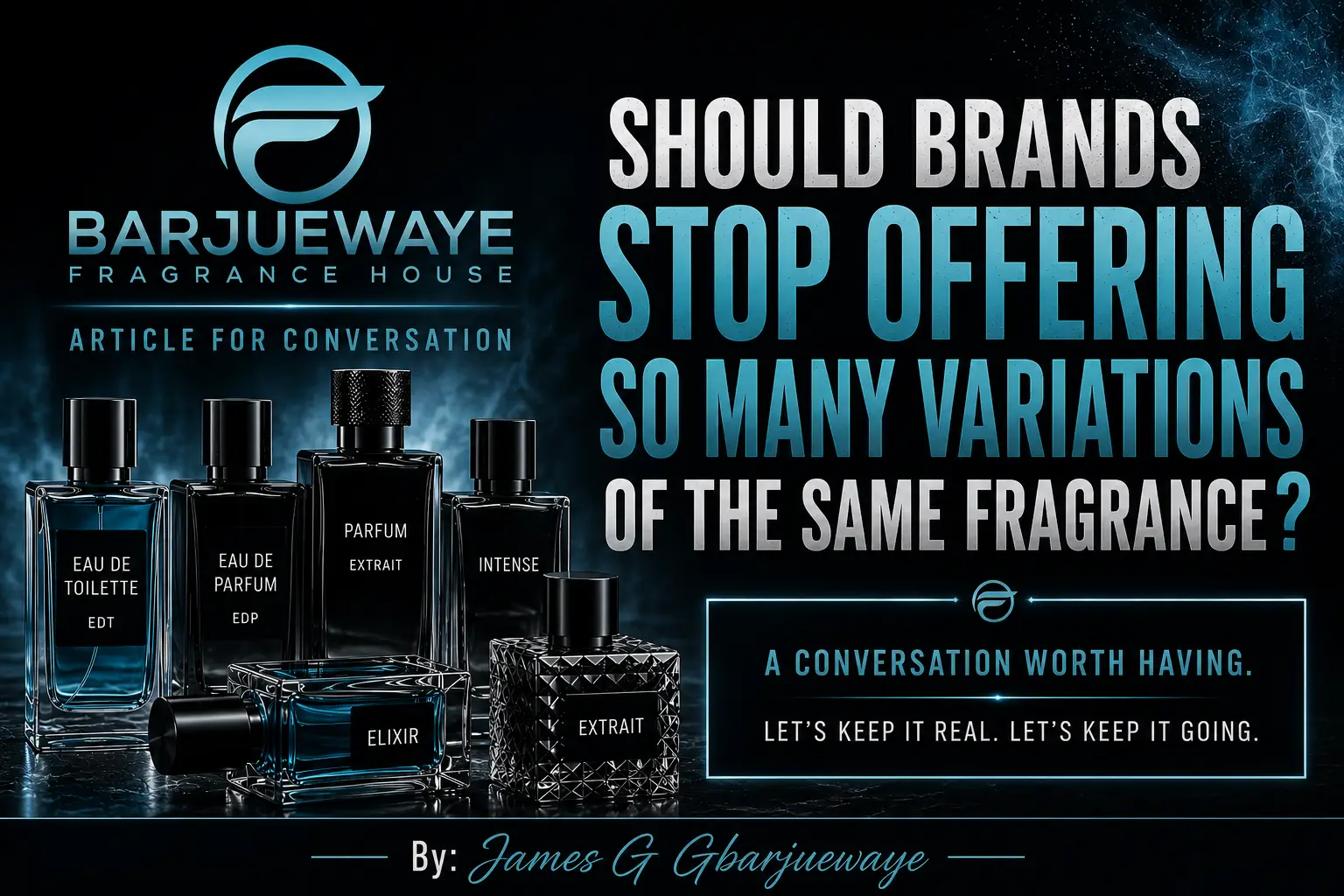
Before we even start this conversation, I would first like to make sure that we are all on the same page by explaining what a fragrance concentration is, the differences between fragrance concentrations, and the different types of fragrance concentrations currently available.
What Is a Fragrance Concentration?
A fragrance concentration refers to the approximate amount of aromatic fragrance material contained in a finished fragrance compared with its alcohol, water, and other components.
Generally, a higher concentration means a greater proportion of fragrance materials. This can result in a richer scent, greater longevity, and sometimes a different wearing experience—but a higher concentration does not automatically mean stronger projection or better performance. The formula itself matters enormously.
Major Fragrance Concentrations
Eau Fraîche
Typical Concentration: 1–3%
Very light, fresh, and refreshing. Generally offers some of the shortest longevity among fragrance concentrations.
Eau de Cologne (EDC)
Typical Concentration: 2–5%
Light and fresh, traditionally featuring citrus and aromatic notes. Usually provides relatively short-lasting performance.
Eau de Toilette (EDT)
Typical Concentration: 5–15%
Lighter and often fresher than an Eau de Parfum. EDT fragrances can provide noticeable projection while maintaining a lighter overall character.
Eau de Parfum (EDP)
Typical Concentration: 15–20%
Generally richer and longer-lasting than an Eau de Toilette. An EDP may also feature changes to the original fragrance’s composition rather than simply being a stronger version of the EDT.
Parfum / Extrait de Parfum
Typical Concentration: 20–40%
One of the highest traditional fragrance concentrations. Usually richer, deeper, and longer-lasting, although a higher concentration does not necessarily mean greater projection.
Elixir
Typical Concentration: No universally established percentage
Usually used by modern fragrance brands to represent an especially rich, intense, or concentrated interpretation of an existing fragrance. Unlike traditional concentration classifications, “Elixir” does not have a universally standardized concentration range.
Important Note: These percentages represent general industry ranges and are not strict standards. Concentrations can overlap between categories and vary depending on the fragrance house and individual formula.
Was It Always Like This?
This is one of those topics that I really feel isn’t spoken about enough, simply because the current era and generation of fragrance consumers and retailers may feel that this is normal—or that this is the way it has always been.
Growing up around the fragrance industry from the early 1990s until now, I personally remember it differently.
Although most of the fragrance concentrations that are available today already existed, it was far less common to see so many of them produced under a single fragrance name. Back in the day, a fragrance might be released as an Eau de Toilette and remain primarily in that concentration throughout its life cycle. Higher-end fragrances might be offered as an Eau de Parfum or Parfum.
From my personal experience growing up around the industry throughout the 1990s and into the 2010s, I also don’t remember seeing nearly as many men’s fragrances marketed in Parfum concentrations as we see today.
One fragrance house I vividly remember offering multiple concentrations of the same fragrance was Chanel. In their case, the strategy made sense to me. Chanel fragrances were positioned at a premium price point, demand was strong, and the different concentrations could occupy different price levels.
Authorized smaller retailers could also receive limited quantities, so high demand combined with controlled inventory meant that stocking multiple versions wasn’t necessarily the problem that it can be today.
But there was another major difference between what I remember Chanel doing then and what many fragrance houses are doing today:
For the most part, the fragrances remained recognizable as members of the same family.
You could smell the connection.
Same Name, Different Fragrance?
Today’s fragrance market can be very different.
A single successful fragrance can eventually have multiple concentrations and variations—and sometimes they don’t smell very much alike at all.
In fact, I sometimes feel that the only thing certain variations of the same fragrance have in common is the name printed on the bottle.
Sometimes I wonder: If a fragrance house changed the name of one of these variations and released it as a completely standalone fragrance, would the average consumer even know that it belonged to an existing fragrance series?
That’s an important distinction.
In today’s fragrance market, an Eau de Toilette, Eau de Parfum, Parfum, and Elixir bearing the same fragrance name are not necessarily the exact same formula offered at different strengths. Fragrance houses may alter notes, ingredients, proportions, or the overall character when creating a new concentration or variation.
At that point, we have to ask:
Are we really talking about different concentrations anymore—or are we talking about entirely different fragrances being sold under the name of an already successful fragrance?
What About the Small Retailers?
Mom-and-pop shops and small independent fragrance stores have long played an important role in the fragrance industry.
Aside from being potentially overwhelming for consumers, I personally feel that the growing number of variations is becoming a stocking, storage, and display nightmare for smaller retailers.
It was one thing when a select number of fragrance houses offered several concentrations, particularly when smaller retailers received limited quantities to begin with.
But when seemingly every level of the market begins following the same strategy, from major luxury houses to mid-level and more affordable fragrance labels, keeping up with every EDT, EDP, Parfum, Intense, Elixir, Absolu, Le Parfum, Extreme, and other variation becomes increasingly difficult.
Think about what that means for a small fragrance store.
One successful fragrance no longer requires space for just one product. The retailer may eventually need shelf and storage space for several versions of that fragrance—and potentially multiple bottle sizes of each version.
Multiply that by dozens of popular fragrance lines, and the amount of inventory a retailer is expected to carry can grow tremendously.
What was once a relatively straightforward decision about whether or not to stock a particular fragrance can now become a decision about which versions of that fragrance a retailer can realistically afford to purchase, display, and keep in inventory.
And unlike a large department store or major retail chain, a small independent retailer doesn’t have unlimited shelf space or storage.
That is the part of this trend that I don’t believe gets discussed enough.
And there’s another important reality: just because a fragrance house produces a new concentration or variation doesn’t mean consumers are necessarily going to buy it.
Not every version of a fragrance sells equally well. One concentration may fly off the shelves while another variation from the exact same fragrance line barely moves. For a smaller retailer, that can mean valuable money and shelf space tied up in inventory that simply sits there collecting dust.
So when fragrance houses continue expanding successful fragrances into more and more variations, the risk isn’t carried by the fragrance house alone. Retailers—particularly smaller independent retailers—also have to decide which versions consumers actually want and which ones may end up sitting on their shelves.
But Can We Really Blame the Fragrance Houses?
I wouldn’t put all of the blame on fragrance labels and fragrance houses.
In life, in business, and in just about anything involving a marketplace, it ultimately comes down to two things:
Supply and demand.
If consumers weren’t buying these fragrances, companies wouldn’t continue manufacturing so many of them.
While I personally feel the industry should slow down, I don’t believe this trend is going to stop anytime soon because it has clearly become an important strategy for fragrance companies.
A successful fragrance name already has something extremely valuable: consumer recognition.
Instead of having to introduce consumers to an entirely new fragrance name, a company can expand an existing successful line with an Eau de Parfum, Parfum, Intense, Elixir, Absolu, Le Parfum, Extreme, or another variation.
The bottle may retain the same basic design with slight alterations. The box and overall presentation may remain recognizable. Most importantly, the fragrance carries a name consumers already know.
This gives fragrance houses the ability to take an already-established fragrance identity and offer consumers multiple new products built around it.
From a business standpoint, I understand exactly why fragrance companies do it.
As a matter of fact, if consumers continue buying them, fragrance houses might be foolish to stop.
But what’s good business for fragrance houses isn’t necessarily what’s best for consumers—or the retailers expected to stock everything they release.
And that’s where I believe the real conversation begins.
What Do You Think?
Have you ever purchased multiple variations of the same fragrance?
Do you think fragrance houses are offering consumers valuable choices, or have there simply become too many versions of the same fragrances?
Do you think fragrance houses should slow down on releasing EDT, EDP, Parfum, Intense, Elixir, and other variations of already successful fragrances?
Or do you actually enjoy having several different interpretations of your favorite fragrance available to choose from?
Would you rather see fragrance houses create more original standalone fragrances instead?
And if you’re a small fragrance retailer or seller, has keeping up with all of these different concentrations and variations become overwhelming from a stocking and display standpoint?
Let us continue this conversation in the comment section!